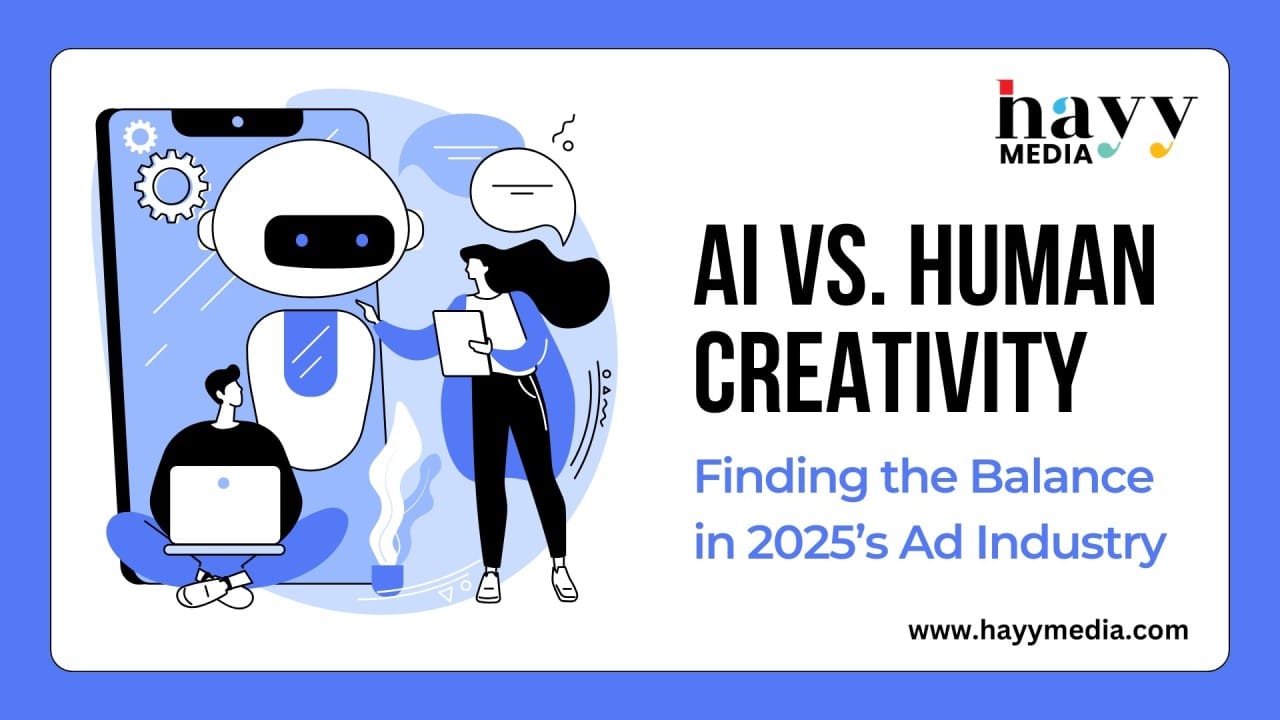
AI vs. Human Creativity: Finding the Balance in 2025’s Ad Industry
- Hayy Media
- February 17, 2025
- Hayy Media, INSPIRATION
- Advertising, AI, Creativity, Human-AI Collaboration, Marketing
- 0 Comments
The Evolution of AI in Advertising
As we step into 2025, AI is no longer a futuristic concept in advertising—it’s the present reality. From personalized ad targeting and predictive analytics to AI-generated visuals and copywriting, artificial intelligence is transforming how brands engage with audiences.
In India, the adoption of AI in marketing has surged, with startups and established brands alike leveraging generative AI tools for ad creatives, chatbots for customer engagement, and machine learning algorithms for consumer insights. But with this rapid adoption comes an important question: Can AI replace human creativity? Or is the real magic in blending both?
What AI Brings to the Table
AI is revolutionizing advertising in ways that were unimaginable a few years ago. Here’s how:
1. Speed & Efficiency
AI can process vast amounts of data, analyze trends, and generate content in seconds, whereas humans might take days to create a campaign. Ad creatives that once required weeks of brainstorming can now be tested and optimized within hours.
2. Hyper-Personalization
With AI-driven tools, brands can deliver personalized marketing at scale—analyzing consumer behavior, predicting preferences, and tailoring content to individual users in real time. E-commerce giants in India are using AI to serve hyper-targeted ads based on browsing history and purchase behavior.
3. Cost-Effective Content Creation
Generative AI can now produce ad copies, videos, and visuals, cutting production costs significantly. AI tools like Runway, Midjourney, and ChatGPT are already enabling Indian brands to create compelling social media content without expensive studio shoots.
4. Data-Driven Insights
AI doesn’t just create—it analyzes. It can track which ad formats work best, when consumers engage the most, and what messaging resonates, helping brands optimize their campaigns with precision.
Why Human Creativity Still Matters
Despite AI’s capabilities, it lacks originality, emotions, and cultural sensitivity—three pillars of great advertising.
1. Emotional Connection & Storytelling
AI can generate content, but it doesn’t “feel.” The best advertisements—whether it’s Fevicol’s iconic ads or Amul’s witty creatives—resonate because they tap into human emotions, nostalgia, and storytelling.
2. Cultural Relevance & Nuance
In India, where regional languages and diverse cultures shape consumer preferences, human creativity is crucial. AI struggles with local dialects, cultural sensitivities, and humor, making it necessary for brands to combine AI-generated insights with human storytelling.
3. Creative Innovation & Originality
AI operates within predefined patterns—it learns from past data but doesn’t invent the future. The most iconic campaigns disrupt norms and create something never seen before, which is a uniquely human ability.
Striking the Right Balance: The Future of AI + Human Creativity
Instead of choosing between AI and human creativity, the future of advertising lies in their collaboration. Here’s how brands can strike the right balance:
✅ AI for Efficiency, Humans for Emotion
Let AI handle data analysis, A/B testing, and content generation, but keep human teams at the helm for concept development, storytelling, and cultural adaptation.
✅ AI as an Assistant, Not a Replacement
AI should be seen as a creative assistant—helping with brainstorming, automating repetitive tasks, and offering data-backed suggestions—while humans provide the final creative touch.
✅ Use AI for Personalization, But Keep Brand Voice Authentic
AI can personalize campaigns at scale, but brands must ensure their messaging remains authentic and consistent—something only human marketers can oversee.
✅ Invest in AI-Driven Creativity Tools
Indian brands should integrate AI-powered design tools (like Canva AI), AI video generators (like Synthesia), and AI-driven copywriting assistants to scale their creativity without losing human essence.
Final Thoughts: AI is an Enabler, Not a Competitor
In 2025, Indian brands that blend AI’s efficiency with human creativity’s depth will dominate the ad industry. AI is not here to replace human creativity—but to amplify it.
The future belongs to those who embrace AI as a creative partner while preserving the emotional intelligence, cultural depth, and originality that only human minds can bring.
DISCOVER MORE ENGAGING CONTENT


Leave A Comment